Argonne National laboratory

ANL ATLAS GROUP

U.S. Department of Energy


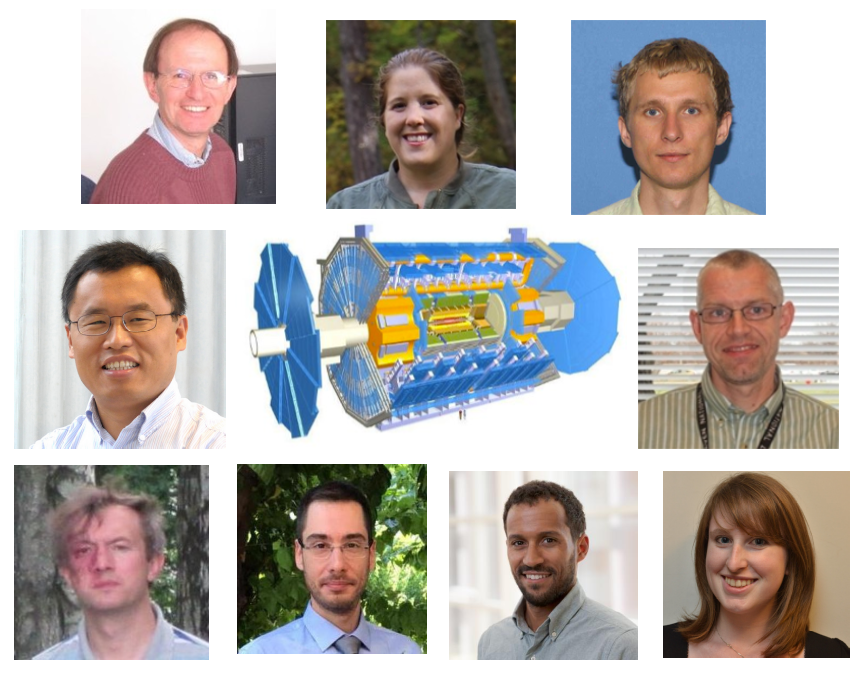
ATLAS is one of the two general purpose detectors being prepared for the Large Hadron Collider at CERN. The ATLAS experiment will be investigating the behavior of matter, energy, space and time and the smallest distance scales ever probed. Located at the Large Hadron Collider at CERN, the European Organization for Nuclear Physics, near , ATLAS will observe the highest energy proton-proton collisions ever achieved. The Argonne HEP Group has played major roles in the hadronic calorimeter, elements of the trigger, and the data handling for the unprecedented data volumes that will be produced in the course of the experiment - and distributed worldwide. We host one of three analysis support centers in the US where we host visitors and hold workshops. The center also has a multi-core computing platform for data analysis and a remote monitoring station which allows detector monitoring shifts to be run at Argonne.

Analysis Support Center

Rik Yoshida

Sergei Chekanov

Esteban Fullana Torregrosa


Scintillating Tile Calorimeter

Jimmy Proudfoot

Larry Price

Bob Stanek

Belen Salvachu

Esteban Fullana Torregrosa

Tom LeCompte

Sergei Chekanov

Rik Yoshida

Larry Nodulman


Software and Computing

David Malon

Jack Cranshaw

Peter van Gemmeren

Sasha Vanyashin

Qizhi Zhang


Trigger and Data Acquisition

Bob Blair

Jinlong Zhang

Denis Fellmann

Sasha Paramonov


Detector Development & Upgrades

Dave Underwood

Bob Stanek

Belen Salvachua


Analysis Support Center (ASC)

The mission of the ASC is to support ATLAS physics analysis for ATLAS physicists at US mid-west Institutes. We are one of the three Analysis Support Centers in the US. We offer a model Tier-3 for ATLAS analysis, physics analysis expertise, software consultation meeting and office space for visitors, a dedicated video conference facility, computer clusters and user accounts. We are also organizing ATLAS analysis workshops and Tier3 meetings


Scintillating Tile Calorimeter

Argonne has contributed centrally to all phases of the ATLAS Tile Calorimeter. Design, prototyping, and fabrication of modules and electronics were carried out in the US in close collaboration with the University of Chicago, University of Illinois. Michigan State University, and the University of Texas at Arlington. Bob Stanek from Argonne was the Project Leader for the Tile Calorimeter System from 2005 until 2009. The modules for Extended Barrel A (EBA), one of three barrel assemblies that comprise the Tile Calorimeter, were assembled and tested at Argonne. In the picture at left, EBA is shown in the ATLAS cavern at the moment of completion of its assembly from 64 separate modules in May 2006. This completed the mechanical installation of the calorimeter (the barrel was installed in December 2004 and EBC in February 2006). The group is now working on calorimeter commissioning, software development and validation, and optimization of the use of the calorimeter signals to reconstruct a measure jets.


Trigger and Data Acquisition

Argonne and MSU have taken responsibility for the Level 2 Supervisor and Region-of-Interest Builder components of the Level 2 trigger. These custom electronics boards route a subset of the information from the detector system to the ATLAS High Level Trigger. The trigger system as a whole reduces the input event rate from 100kHz to a few kHz on the basis of the information from the RoIB and eventually, following further processing, to ~200 kHz for storage and physics analysis


Software and Computing

Argonne is the central site for work on database and data management. The group has key responsibilities in the design and implementation of the I/O model which must provided distributed access to many petabytes of data for both event reconstruction and physics analysis.


Physics and Performance

The group is working on a variety of physics and performance topics. One focus in the group is to study physics processes which rely crucially on the performance of the ATLAS calorimeters to measure jets and missing transverse energy: QCD production of jets, TTbar pairs and beyond the standard model processes such as those involving extra dimensions or quark compositeness. As part of this focus we are involved in the optimization of the calorimeter response to jets (being proponents of the method based on cell energy density weighting) and are heavily involved in the ATLAS JetEtMiss Combined Performance group.


Links to other ATLAS pages

ATLAS page for general public

ATLAS Collaboration home page

US ATLAS home page